


AlterMega
Client interaction flow
Data and results
Data sources
AlterMega
Automated dynamic sales management system for marketplaces.



Client documents
Marketplace data
Seller API keys
Delivery of results
Web application with charts and analytics
Reports in an agreed format
API integration with BI systems

|

contact us
Pricing
AlterMega
AI solutions

Chatbots and virtual assistants: 24/7 customer support
Forecasting: sales analysis, customer behavior and market dynamics
AI customization for specific business needs
Natural language processing (NLP): automated text parsing and analysis, report generation, customer inquiry classification
II Technology is not about "set it and forget it".
It's about profit, scale and full control at every stage.
It's about profit, scale and full control at every stage.
Business process automation: implementing intelligent systems that reduce operational costs and speed up routine tasks

Metrics
I. Conversion phase metrics
(PCE) – Phase Conversion Elasticity

(CPSI) – Conversion Phase Saturation Index
(PDI) – Phase Desynchronization Index
II. Advertising pressure metrics
(RT-API) – Real-Time Advertising Pressure Intensity
(AEDR) – Ad Effectiveness Degradation Rate
(PA-ROMI) – SKU phase-adjusted advertising ROMI
III. Pricing and promotional metrics
(DPFI) – Dynamic Price Flexibility Index
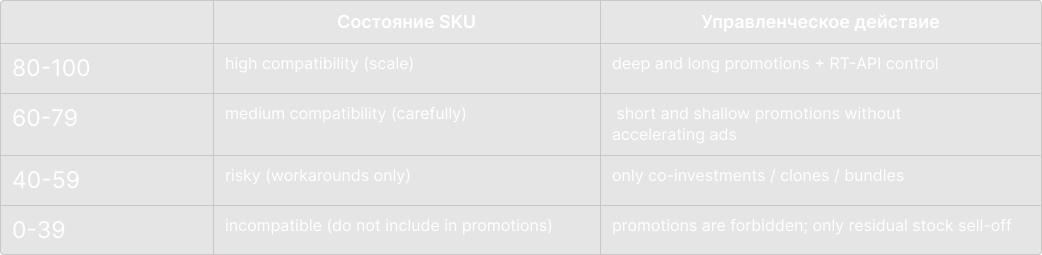
(APC) – SKU Promotional Pressure Compatibility
(PCSI) – Price Change Conversion Stability Index
IV. Predictive metrics
(OPM-24) – 24-Hour Outcome Probability Matrix
(EDP) – Pre-event Degradation Probability
(AIF) – Management Action Effect Forecast
V. Goal-setting metrics
(GAE) – Goal Achievement Elasticity
(SDI) – Strategy Deviation Index
(ATS) – Marketplace Algorithm Trust Score for SKU
VI. System management metrics
(SCI) – SKU Controllability Index
(MRD) – Management Response Delay

Conversion phase metrics
I.
Phase Conversion Elasticity (PCE) — measures how each funnel phase responds to management actions.
Why it matters:
Example:

Ads ↑ → CR1 grows, CR2 doesn't → the problem is not traffic
Discount ↑ → CR2 doesn't grow → phase degradation
Core concept:
PCE shows how sensitive a phase's conversion is to changes in its key driver. It's classical elasticity — applied inside the marketplace funnel
Key innovation:
Conversion is treated as a living system, not a static coefficient
Identifies exactly where the funnel is broken in real time
Prevents pointless actions (e.g. increasing ad spend when the problem lies elsewhere)
What it measures:
How each phase (CR0, CR1, CR2) responds to management actions at any given moment

Conversion Phase Saturation Index (CPSI) — identifies when a phase has reached its effectiveness limit.
Why it matters:
Example:
CR1 saturated → further listing improvements produce no effect
CR2 saturated → promotions stop driving additional orders
Shows when additional effort becomes counterproductive
Identifies the moment of transition:
Growth → plateau
Plateau → decline
What it measures:
Whether a specific phase has hit its performance ceiling


Phase Desynchronization Index (PDI) — measures how unevenly funnel phases are developing.
Why it matters:
Example:
CR0 ↑↑, CR1 →, CR2 ↓ → ad spend is destroying unit economics
Early warning signal of degradation
Foundation for preventive management
What it measures:
The degree of imbalance across phases CR0–CR2


Advertising pressure metrics
II.
Real-Time Advertising Pressure Index (RT-API) — measures the intensity of advertising pressure at any given moment.
Why it matters:
Advertising is evaluated not by spend, but by timing and relevance
What it measures:
How well the advertising pressure matches the current SKU phase and demand state. The exact RT-API value is known only to the marketplace
Interpretation:

Insufficient pressure
Optimal delivery pressure
Destructive pressure
Takes into account:
Competitors
Bids
Search results saturation
Lifecycle phases

RT-API is an index that shows how "overheated" the ad market is at any given moment for a specific SKU / cluster / search query.

Advertising Efficiency Decay Rate (AEDR) — measures how quickly advertising loses its effectiveness.
Why it matters:
Example:
Today: +10% budget = +8% orders
Tomorrow: +10% budget = +2% orders
Signal to reduce bids
Protection against budget burnout
What it measures:
How fast advertising returns diminish over time
Formula as the derivative of efficiency:


AP – advertising pressure
Pos – search result position
ROMI – current advertising effectiveness
T – time
k – category sensitivity coefficient
α > 1 – accelerated degradation as pressure increases
β > 0 – "overbidding" effect / traffic cannibalization at top positions
Pos – search result position
ROMI – current advertising effectiveness
T – time
k – category sensitivity coefficient
α > 1 – accelerated degradation as pressure increases
β > 0 – "overbidding" effect / traffic cannibalization at top positions
Phase-Adjusted Advertising ROI (PA-ROMI) — advertising ROMI adjusted for the current SKU lifecycle phase.
PA-ROMI < 1 is not always bad. It only becomes a problem when it falls below the norm for that specific phase.
Why it matters:
Example:
High ROMI in the growth phase → scale up
The same ROMI in the decline phase → temporary effect
The same ROMI value means something different depending on the phase
What it measures:
The true effectiveness of advertising within the current lifecycle phase

III.
Pricing and promotional metrics
Dynamic Price Feasibility Index (DPFI) — measures whether a price change is viable right now.
Why it matters:
DPFI answers the question: "Is the current price actually viable RIGHT NOW — not just 'on average'?"
What it measures:
Whether it is currently safe to:
DPFI = f (Price index, Demand volume, Price stability, Competitive pressure, SKU algorithmic cycle…)
without damaging CR2 or SKU history
DPFI is the price viability index for a SKU at its current market phase

raise the price
lower the price
participate in a promotion
Taking into account:
SKU lifecycle phase
Competitive landscape
Current demand
Marketplace algorithmic sensitivity
Funnel response (CR0–CR2)

Action Pressure Compatibility (APC) — measures whether a SKU is ready for promotional pressure.
Why it matters:
A SKU is compatible with promotions only when all of the following are true simultaneously:
If any condition is not met → the promotion carries risk
Where: w1+w2+w3+w4=1
MB — Margin Buffer (margin buffer available for discounting)
DPFI — price viability as accepted by the market (proxied via PI or price position)
RT — RT-API comfort level (auction temperature)
ROMI — advertising effectiveness (proxy for the current phase)
MB — Margin Buffer (margin buffer available for discounting)
DPFI — price viability as accepted by the market (proxied via PI or price position)
RT — RT-API comfort level (auction temperature)
ROMI — advertising effectiveness (proxy for the current phase)
ROMI > 1.2 (or the business benchmark)
DPFI is high and growing
RT-API ≤ average
SKU is in the growth or scaling phase

Price-Conversion Stability Index (PCSI) — measures how stable conversion remains when prices change.
Why it matters:
Prevents the risk of breaking CR2 through pricing maneuvers
What it measures:
The risk of damaging CR2 when making price adjustments
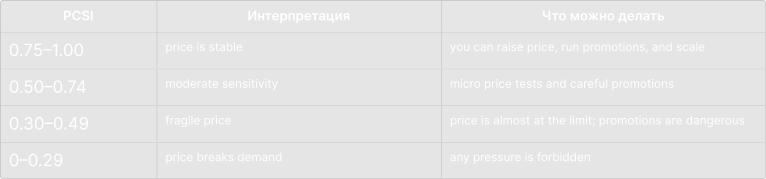

Where:
ε — a small number (e.g. 0.01) to avoid division by zero clip(..., 0, 1) — range limiter

Predictive metrics
IV.
Growth
Plateau
Decline
24h Outcome Probability Matrix (OPM-24) — outcome probability matrix.
Why it matters:
The foundation of preventive management
What it measures:
The probability of each scenario over 24 hours:
For each outcome O_j:
Where S_i — normalized signals
W_(ij) — signal weights for a specific outcome
W_(ij) — signal weights for a specific outcome

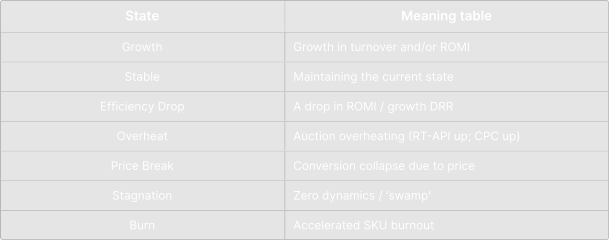
SKU TODAY
8%
Growth
18%
Stable
34%
Efficiency Drop
27%
Overheat
10%
Price Break
3%
Burn
24h Outcome Risk-Map (outcome probabilities)
S_(ROMI) — 1 if ROMI has been declining for more than 2 consecutive days
S_(RT) — normalized growth
RT-API PCSI — price stability
DPFI — price viability
S_(opm_neg) — total probability of negative OPM-24 outcomes
S_(RT) — normalized growth
RT-API PCSI — price stability
DPFI — price viability
S_(opm_neg) — total probability of negative OPM-24 outcomes
CR2
GMV
margin — before any drop appears in reports
Early Degradation Probability (EDP) — probability assessment of degradation before it becomes visible in reports.
Why it matters:
EDP is an early warning metric. It measures the probability that a SKU has already entered a degradation phase — even when ROMI, revenue and sales still look "normal"
What it measures:
Risk of decline in:
+ CHECKLIST
Pre-planned actions for each scenario

Action Impact Forecast (AIF) — forecast of the effect of a specific management action.
Why it matters:
AIF shifts the mindset from:
+10% bid
entering a promotion
changing the price
"How do I grow faster?"
"What action will cause the least harm tomorrow?"
"What action will cause the least harm tomorrow?"
AIF answers the question: "If I take a specific action RIGHT NOW — what is most likely to happen next?"
What it measures:
The probable outcome of a specific action:
AIF is an assessment of the likely change in SKU state following a SPECIFIC management action within a 24–72 hour window.
The best action is not the one that drives growth — it's the one that reduces the probability of negative outcomes.

V.
Goal-setting metrics
GMV
Margin
GMV + Margin
Goal Attainment Elasticity (GAE) — measures the elasticity of goal achievement.
Why it matters:
Goal Attainment Elasticity (GAE) is the sensitivity of goal achievement probability to management actions.
A goal is not an action — it is a state.
Elasticity is always calculated relative to a specific goal.
Typical goals:
ROMI ≥ 1.5
EDP < 0.25
Growth ≥ 25%
RT-API ≤ 100%
Stability (OPM-24: Stable + Growth ≥ 60%)
SKU exit from degradation
EDP < 0.25
Growth ≥ 25%
RT-API ≤ 100%
Stability (OPM-24: Stable + Growth ≥ 60%)
SKU exit from degradation
What it measures:
How much current actions move the SKU closer to the goal:
We select a set of reasonable actions (not extreme ones)
For each reasonable action a:
Where:
max (Pₐ) — the highest goal probability among all available actions
C — "cost of action" (effort, risk, resources)
C — "cost of action" (effort, risk, resources)

GMV growth with PA-ROMI ≥ 1
Stabilization with EDP < 0.3
ATS accumulation
Inventory offloading without damaging SCI
Reaching scaling phase within 2–3 weeks
Strategy Drift Index (SDI) — strategy deviation index / strategic drift index.
Why it matters:
SDI is always calculated relative to a specific goal. It identifies and measures the gap between the declared (or chosen) strategy and the actual management actions taken and their effects.
What it measures:
When tactical actions begin to contradict the stated goal
What counts as a "strategy" in SDI logic
A strategy is a target state, not a list of actions.
SDI is always calculated relative to a specific goal.
Examples of strategic goals:

EDP
Risk axis

OPM-24 (negative mass)
PA-AROM
Economic axis
ROMI
AEDR
ATS
Algorithmic axis
RT-API
SCI
Controllability
MRD (as a penalty)

Algorithmic Trust Score (ATS) — the marketplace algorithm's trust level toward a SKU.
Why it matters:
ATS ≥ 0.75 — the algorithm "trusts" the SKU: ads, prices and promotions can be scaled carefully
0.55–0.74 — moderate trust: growth is possible, but only with RT-API and PCSI under control
0.35–0.54 — low trust: any pressure is risky, focus on stability
<0.35 — "test mode": the algorithm cuts organic reach, ad costs increase
Sales history
CR2 stability
Returns
Traffic response
A synthetic metric based on:
GMV
Purchase rate
Returns
User satisfaction
Repeat purchases
The marketplace optimizes not your profit, but:
This is one of the most underrated yet critical hidden factors in marketplaces. It is essentially the reason why two SKUs with identical pricing and ad spend produce radically different results.

VI.
System management metrics
SCI answers the question:
This is not about efficiency — it's about controllability.
"How responsive is the SKU to available levers (ads, price, promotions, traffic) without destabilizing the system?"
ROMI looks good
ATS seems fine
The SKU was UNCONTROLLABLE — even when the numbers looked fine
SCI is needed to answer:
whether it is safe to act on the SKU
or whether any action will make things worse
Price can be adjusted
Ads are paying off
start "turning the dials"
SKU degrades
SKU Control Index (SCI) — measures how controllable a SKU is.
Why it matters:
What it measures:
Common SKU management mistake:
Predictable
Stable
Responsive to management actions
How well a SKU is:
What it measures:

A key metric of management maturity
The time between the appearance of an EARLY problem signal and the actual management action taken
Not the time between "ROMI dropping" and action — but between the early signal and action.
Management Reaction Delay (MRD) — measures the delay between an early warning signal and the management response.
Why it matters:
What it measures:
EDP crosses 0.45 (yellow-orange threshold)
SCI drops below 0.55
ATS begins a sustained decline
OPM-24: negative outcomes > 50%
AEDR > 3–4% per day
MRD starts BEFORE the fact — not after
Typical MRD trigger events:
A change in the environment
The correct responsive action
The time elapsed between:
MRD is:
Important:
MRD is measured in days (sometimes hours)


Still have questions
Contact us:
Social media:
© 2026 All rights reserved
Business address:
ООО «II Technology»
Taxpayer Identification Number (INN): 9714008756
Primary State Registration Number (OGRN): 1237700281125
125315, Moscow, Leningradsky Ave., 66, office 1N
Taxpayer Identification Number (INN): 9714008756
Primary State Registration Number (OGRN): 1237700281125
125315, Moscow, Leningradsky Ave., 66, office 1N
By clicking "Submit", you agree to the processing of your personal data and accept the Privacy Policy


By submitting this form, you agree to the processing of your personal data.
Leave a Request
This site uses cookies to ensure it works properly and provides a smooth experience. By continuing to browse, you agree to their use.